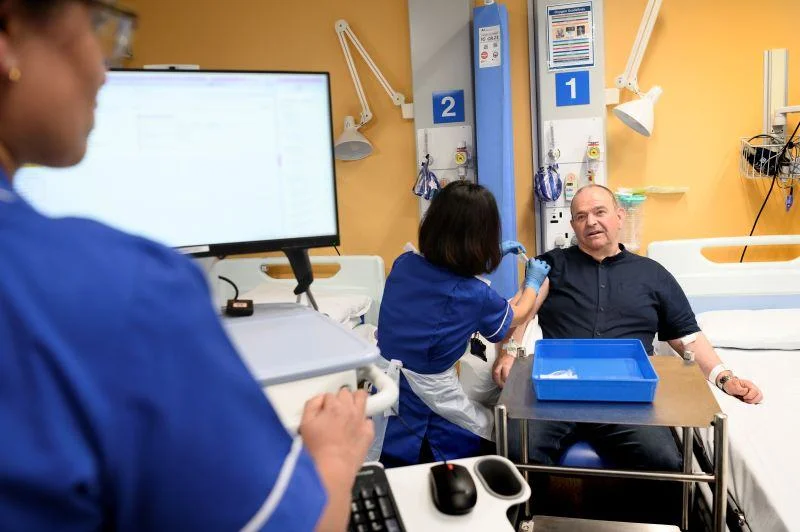

A personalised mRNA vaccine tested at Addenbrooke's cut the risk of melanoma returning or death by 42%. Full results go to a Madrid cancer conference today.
A personalised skin cancer vaccine tested on patients at Addenbrooke’s Hospital cut the risk of their melanoma coming back, or of them dying, by 42%. That is the headline result of an international phase three trial, which Cambridge University Hospitals (CUH) published on 23 October. The full results are due to be presented today, Saturday 24 October, at the European Society for Medical Oncology (ESMO) conference in Madrid.
Addenbrooke’s was one of the hospitals running the trial. More than 1,000 patients with high-risk melanoma took part worldwide, the trust said. Melanoma is the deadliest form of skin cancer.
What the trial found
Every patient had already had their melanoma removed by surgery. They were then given one of two treatments for around a year:
- the personalised vaccine plus Keytruda, an immunotherapy drug already used on the NHS
- Keytruda alone
According to CUH, adding the vaccine:
| Measure | Reduction compared with Keytruda alone |
|---|---|
| Risk of the cancer returning, or death | 42% |
| Risk of the melanoma spreading, over two years | 38% |
The trial was double blind. Neither the patients nor the researchers know which treatment each person received.
The drug makers, Merck (known as MSD in Europe) and Moderna, first said in August that the trial had met its main goals. Their August announcement gave no figures. It said the vaccine’s safety record matched earlier studies, with no new safety concerns. The trial is called INTerpath-001.
How the vaccine works
The vaccine is called intismeran. It uses mRNA technology, the same approach behind some Covid-19 vaccines.
After surgery, a fragment of the patient’s own tumour is sequenced. The vaccine is then made for that one patient. It is designed to train their immune system to find and attack any cancer cells left behind.
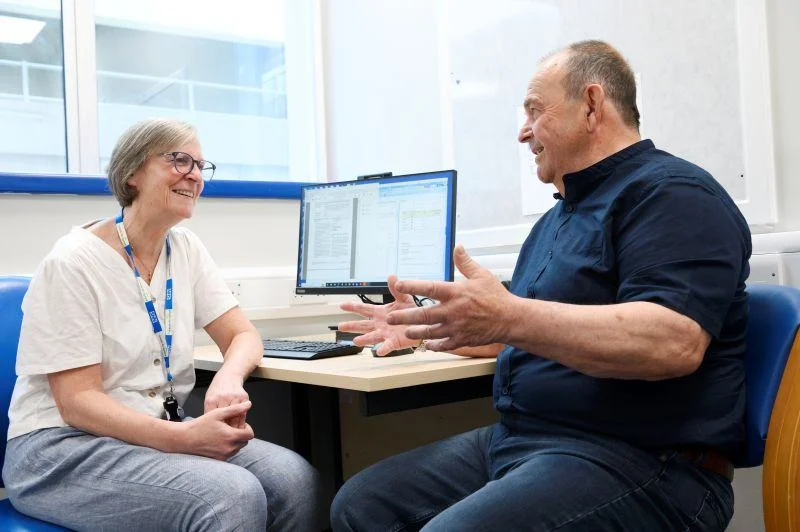
Professor Pippa Corrie, a consultant medical oncologist, led the trial at Addenbrooke’s. She is also an affiliated professor at the University of Cambridge.
“It is a whole new approach to cancer treatment which is designed to improve outcomes compared with standard anticancer drug treatments that don’t take into account individual differences, and this trial was the first proof of principle,” she said.
A patient who was born at Addenbrooke’s
Tony Chapman, 75, is a retired businessman from North Northamptonshire, about 50 miles north-west of Cambridge. He was diagnosed with stage three melanoma in 2019, and a melanoma on his chest was removed.
Four years later he found a lump under his armpit and needed surgery to remove lymph nodes. He then joined the trial. He finished his treatment at the NIHR Cambridge Clinical Research Facility last year and remains cancer free, CUH said.
“Addenbrooke’s has a sentimental place in my heart as I was born here, so I didn’t hesitate when I first heard about the research trial,” he said.
His check-up scans have now dropped from every three months to every six. “I’m feeling positive, I’m feeling well and I’m making the most of what life has to offer,” he said.
What it means for you
- The vaccine is not available yet. The results have not been peer reviewed. Regulators would also have to approve it before it could be offered on the NHS, the trust said.
- It is for melanoma after surgery. The trial tested it in people whose high-risk melanoma had already been removed, alongside Keytruda.
- Check your skin. The NHS lists the warning signs of melanoma, such as a new mole or a change in an existing one, on its melanoma skin cancer page. See a GP if you notice a change.
- More trials are coming to Cambridge. CUH says this kind of personalised treatment is what the planned Cambridge Cancer Research Hospital is for. It will bring research and NHS care into one building on the Cambridge Biomedical Campus, close to the new Maggie’s centre.
Source: Cambridge University Hospitals, 23 October 2026. CUH has also published a video interview with Tony Chapman and Professor Corrie.
Have your say