
Band D in Cambridge is £2,467.02 in 2026/27, up £111.61. The full band A to H table, and why the city council keeps just £239.07 of what you pay.
A band D home in Cambridge pays £2,467.02 in council tax in 2026/27. That is £111.61 more than last year, a rise of 4.74%.
Cambridge City Council sends the bill and takes the complaints. It keeps £239.07 of it, which is 9.7%. The other £2,227.95 is collected on behalf of four other bodies.
The full band A to H table for 2026/27
| Band | Property value in April 1991 | Total 2026/27 |
|---|---|---|
| A | Up to £40,000 | £1,644.68 |
| B | £40,001 to £52,000 | £1,918.79 |
| C | £52,001 to £68,000 | £2,192.91 |
| D | £68,001 to £88,000 | £2,467.02 |
| E | £88,001 to £120,000 | £3,015.25 |
| F | £120,001 to £160,000 | £3,563.47 |
| G | £160,001 to £320,000 | £4,111.70 |
| H | Over £320,000 | £4,934.04 |
Source: the council’s council tax bands and charges page. Bands are set on what a property was worth on 1 April 1991, not today.
One table covers the whole city. There is no parish precept line on a Cambridge bill, so the charge is the same in Arbury, Trumpington, Cherry Hinton and Newnham alike. That is unusual locally. In East Cambridgeshire, for instance, the band D charge ranges from £2,405.73 in Westley Waterless to £2,559.00 in Wentworth, purely because of the parish share.
Where the £2,467.02 goes
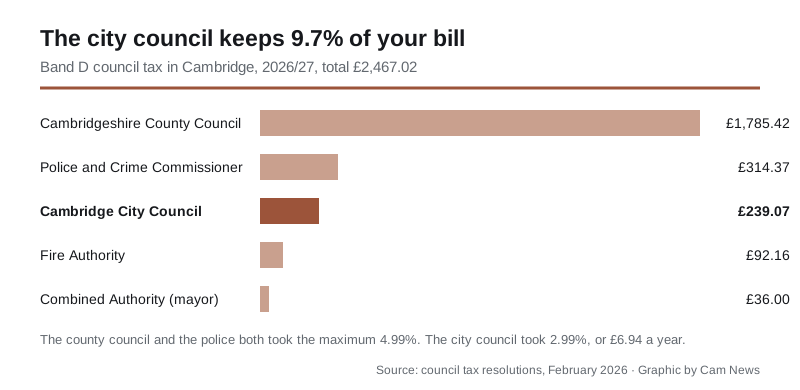
| Authority | 2025/26 | 2026/27 | Change |
|---|---|---|---|
| Cambridgeshire County Council | £1,700.64 | £1,785.42 | +£84.78, 4.99% |
| Police and Crime Commissioner | £299.43 | £314.37 | +£14.94, 4.99% |
| Cambridge City Council | £232.13 | £239.07 | +£6.94, 2.99% |
| Cambridgeshire and Peterborough Fire Authority | £87.21 | £92.16 | +£4.95, 5.68% |
| Cambridgeshire and Peterborough Combined Authority | £36.00 | £36.00 | No change |
| Total | £2,355.41 | £2,467.02 | +£111.61, 4.74% |
The 2026/27 figures come from the statutory council tax resolution the county’s billing authorities set in February 2026, which lists the four county-wide precepts side by side. East Cambridgeshire District Council’s version is published in full. The 2025/26 column is from the city council’s own what your council tax pays for page, which as of 30 August 2026 had not been updated for the current year.
Three things are worth pulling out of that table.
The county council’s 4.99% is the legal maximum, made up of a 2.99% base rise plus a 2% adult social care precept. Central government now requires that precept to be merged into a single county figure on the bill rather than shown separately.
The city council took the smallest rise of the five, at 2.99% or £6.94 a year. Its budget setting report puts that at around 13p a week. Because its share is under a tenth of the bill, even a large percentage rise at the Guildhall barely moves the total.
The mayoral precept has not moved. The combined authority has held its band D charge at £36.
The city council’s own share, band by band
If you want to know what Cambridge City Council itself charges rather than what the bill totals, its budget setting report gives the whole range:
| Band | 2025/26 | 2026/27 | Increase |
|---|---|---|---|
| A | £154.75 | £159.38 | £4.63 |
| B | £180.55 | £185.94 | £5.39 |
| C | £206.34 | £212.51 | £6.17 |
| D | £232.13 | £239.07 | £6.94 |
| E | £283.71 | £292.20 | £8.49 |
| F | £335.30 | £345.32 | £10.02 |
| G | £386.88 | £398.45 | £11.57 |
| H | £464.26 | £478.14 | £13.88 |
The council set its budget against a tax base of 46,562.0 band D equivalents, drawn from 55,720 chargeable dwellings across the city.
Checking and challenging your band
Your band is set by the Valuation Office Agency, not the council, and the council cannot change it. Look yours up on the VOA’s council tax band search, which is free and needs only a postcode.
If you think it is wrong, the VOA calls this a challenge or proposal. Two points people miss:
- A challenge can move a band up as well as down, and it applies to the property, not to you.
- You must keep paying the current bill while the case is open. Stopping payment triggers recovery action.
Cambridge has a lot of band B and C stock. On the council’s own tax base figures, band C is the largest single band in the city at 19,899 chargeable dwellings, ahead of band B at 10,505 and band D at 9,835.
Discounts and reductions
Single person discount: 25%. You qualify if you are the only person aged 18 or over living at the property as your main home.
Disregards: also 25%. Some adults are not counted when the council works out how many people live somewhere. The list includes full-time students, student nurses, apprentices and youth trainees, school and college leavers, people with a severe mental impairment, live-in carers, hospital and care home residents, and people in prison or detention. If everyone but one adult is disregarded, you get the same 25% as a single occupier.
Being disregarded does not remove liability for the bill. It only changes the discount.
Council Tax Reduction: up to 100%. Cambridge’s scheme is for residents on low incomes and can wipe out the whole bill. Working-age claimants on Universal Credit are placed in income bands, with a weekly contribution set by earnings: nothing under £96 a week, £8 from £96, and rising in steps to full liability at £578 and above. Savings over £16,000 rule you out.
Students. A property occupied entirely by full-time students is exempt, not discounted. That matters in a city where two universities put tens of thousands of students into private housing.
Empty homes and second homes pay double
Cambridge charges a 100% premium, meaning double the normal bill, on:
- homes that have been empty and unfurnished for more than 12 months
- furnished second homes that are nobody’s sole or main residence
The council agreed the second-homes premium at its Strategy and Resources committee on 25 March 2024. Full details are on its empty and second homes page.
At band D that turns a £2,467.02 bill into £4,934.04, the same as a band H property paying the standard rate.
Related
- Cambridge house prices
- Cambridge bin collection days, a service your county and city shares fund between them
- Parking in Cambridge
Have your say