
Hills Road awarded 47% of grades at A* or A and 17% at A*, against 25.6% at sixth form colleges nationally. Every Cambridge figure and the remark deadline.
Hills Road Sixth Form College awarded nearly half its A-level grades at the top two marks this year. The college said 47% of its grades were at A* or A and 17% were A*, with more than three quarters at A* to B and 99.9% at A* to E. (Hills Road Sixth Form College)
That is against 27.9% at grade A or above across the whole of the East of England, on the national statistics Ofqual published the same morning, Thursday 13 August. (Ofqual)
Five Cambridge institutions have now published something about how their students did. Two put out full percentages, one published a headline pass rate for vocational courses, one profiled individual students without releasing figures, and one released a partial set. Here is what each of them actually said, and what the national tables let you compare it with.
Hills Road A-level results 2026
Hills Road Sixth Form College reported 17% of grades at A* and 47% at A* or A, with over three quarters at A* to B and 99.9% at A* to E. Extended Project results set a college record for the third year running, with more than one in four projects at A*. This was the college’s first results day inside the Hills Education Trust, set up in September 2025, and the last under Principal Jo Trump, who said the results reflected “the commitment that this cohort have shown throughout their time at Hills Road”. (Hills Road Sixth Form College)
The number worth holding on to is the comparison with colleges like it, not with schools. Sixth form colleges across England awarded 25.6% of entries at A or above this summer. Hills Road’s 47% is 21.4 percentage points clear of that, and well above the England all-centres figure of 28.3% and the East of England’s 27.9%. It sits below The Perse, the fee-charging school half a mile up the same road, which reported 76%, but The Perse selects on entry and charges fees, and Hills Road does neither in the same way.
What each Cambridge college and school reported
The Perse School, the independent school on Hills Road, reported 76% of A-level entries at A* or A and 40% at A*, with 95% at A* to B. It said 126 pupils secured three or more grades at A* or A, and 44 pupils, just under a quarter of those sitting A-levels, got three or more A* grades. More than 80% of entries were at A* or A in art, biology, computer science, economics, geography, German, maths, further maths, music, physics and religious studies. (The Perse School)
The Leys, the independent school on Trumpington Road, said one in six pupils achieved an A* grade, half of all grades were at A to A*, and almost 80% were at A* to B. A third of pupils achieved at least three A grades. The school said 87% of pupils secured the grades they needed for their first-choice university. (The Leys)
Cambridge Regional College published its Level 3 figures rather than A-levels. 1,285 students across its Cambridge and Huntingdon campuses collected BTEC, University of the Arts London and T Level results, with a 95% overall pass rate and 71% of BTEC Extended Diploma students at Merit or Distinction. Its T Level students recorded a 100% pass rate. This was the first year a CRC cohort finished the T Level in construction and the built environment, and the college said every one of those students achieved a Merit or a Distinction. Principal and chief executive Mark Robertson said technical skills are in high demand and that colleges like CRC “are key to driving local growth”. (Cambridge Regional College)
Long Road Sixth Form College published no aggregate figures. Its results-day post celebrated individual students heading to Oxbridge and Russell Group universities, competitive degree apprenticeships and work. (Long Road Sixth Form College)
Cllr Edna Murphy, chair of Cambridgeshire County Council’s children and young people committee, congratulated students across the county and said achievements like these are “only possible because of the teachers, families, and communities that are committed to helping our young people succeed”. (Cambridgeshire County Council)
How that compares nationally
Ofqual’s regional table puts the East of England on 27.9% of results at grade A or above and 77.9% at C or above, from 98,595 A-level results. The region is third of the nine English regions on top grades, behind London on 32.7% and the South East on 31.5%. Across England, 28.3% of results were at A or above and 78.1% at C or above, from 835,950 results issued to 320,505 students.
The regional figure barely moved: the East of England was on 28.0% at A or above last year and 77.8% at C or above, so top grades are down a tenth of a point and C-and-above is up a tenth. The number of results in the region rose by 1,710.
Centre type matters far more than geography, and Ofqual publishes that too. Nationally, independent schools recorded 48.6% of results at A or above and grammar schools 43.4%, against 25.6% at sixth form colleges, 23.5% at academies, 23.0% at local-authority maintained comprehensives and 12.8% at further education establishments.
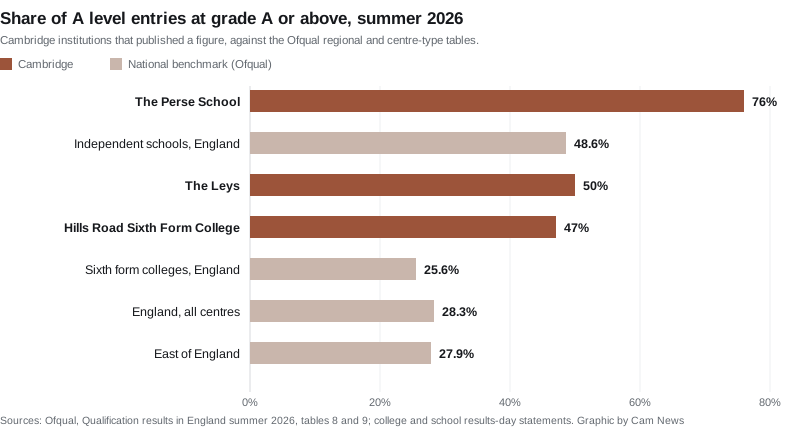
Set against its own centre type, Hills Road’s 47% is 21.4 percentage points above the national sixth form college figure of 25.6%. The Perse’s 76% is 27.4 points above the national independent school figure of 48.6%. The Leys’ 50% is 1.4 points above it.
The comparisons that do not work, and why
Three cautions before anyone builds a league table out of the numbers above.
Ofqual does not publish A* on its own. Tables 8 and 9 of the official statistics report the share at grade A and above and at grade C and above, and nothing between. So Hills Road’s 17% at A* and The Perse’s 40% cannot be checked against a regional or centre-type figure, because no such published figure exists. Take those as the schools’ own numbers.
A* to B has no national equivalent at all. Ofqual publishes A-and-above and C-and-above. A school’s A* to B share can only sensibly be set against its own previous years, never against a regional average, and the same goes for A* to E.
Ofqual’s area map is not a ranking of local schools. Since 7 August the regulator has published A-level outcomes by local authority district. It assigns each result using the postcode of the exam centre from the National Centre Number register, not where the student lives. Cambridge contains two large sixth form colleges and several independent schools drawing students from well beyond the city boundary, so any district figure for Cambridge is measuring where exams were sat, not how the city’s own children did.
There is one more reason the Cambridge picture is not directly comparable with most towns. In many places, A-levels are taken at school sixth forms attached to secondary schools. In Cambridge, the state route runs overwhelmingly through Hills Road and Long Road, two standalone sixth form colleges, so the city’s state A-level results sit in a centre type that nationally records 25.6% at A or above, a little above academies and comprehensives and well below grammar and independent schools.
Common questions
What were the Hills Road A-level results in 2026?
47% of entries were graded A* or A and 17% were A*, with more than three quarters at A* to B and 99.9% at A* to E. Extended Project results set a college record for the third year running, with over a quarter graded A*.
How do Hills Road’s results compare with other sixth form colleges?
Sixth form colleges across England awarded 25.6% of entries at grade A or above in summer 2026. Hills Road’s 47% is 21.4 percentage points above that, and above the England figure for all centres of 28.3%.
Which Cambridge school had the best A-level results in 2026?
Of the results published, The Perse School reported the highest share at 76% of entries at A* or A, followed by The Leys at 50% and Hills Road at 47%. The Perse and The Leys are independent schools that select on entry, so the three are not measuring the same thing.
When is the deadline to challenge an A-level grade?
Requests go through your school or college, and the JCQ deadline for a review of results is 24 September 2026.
What it means for you
If a grade is not what was expected, the routes back are open now and the deadlines are close.
- A priority review of marking must reach the exam board by 20 August. It covers A-level, T Level and level 3 vocational qualifications, and boards complete it within 15 calendar days.
- A standard review of marking and a clerical re-check both close on 24 September, completed within 20 and 10 calendar days. A clerical re-check only confirms the marks were added up and recorded correctly, it does not look at the marking again.
- The request goes through the college’s exams officer, not the student directly, and the student’s written consent is needed first.
- A grade can go down. Exam boards must tell candidates in writing, before consent is given, that marks and subject grades can fall as well as rise. That is the single most common surprise of results week. (JCQ)
For students who want to talk to someone in person, Cambridge Regional College is running advice sessions at its Cambridge and Huntingdon campuses on weekdays from 20 to 28 August, covering post-16 study, T Levels, apprenticeships and higher education. Drop-ins are accepted but the college recommends booking. (CRC)
The county council pointed students at the National Careers Service, on 0800 100 900 or at nationalcareers.service.gov.uk, for advice on what to do next.
GCSE results follow on Thursday 20 August, when Ofqual will add level 1 and level 2 outcomes to the same release. We will publish the Cambridge GCSE figures as schools put them out.
For anyone whose next step means staying in the city, our guides to Cambridge house prices and trains from Cambridge to London set out what that actually costs.
Have your say