
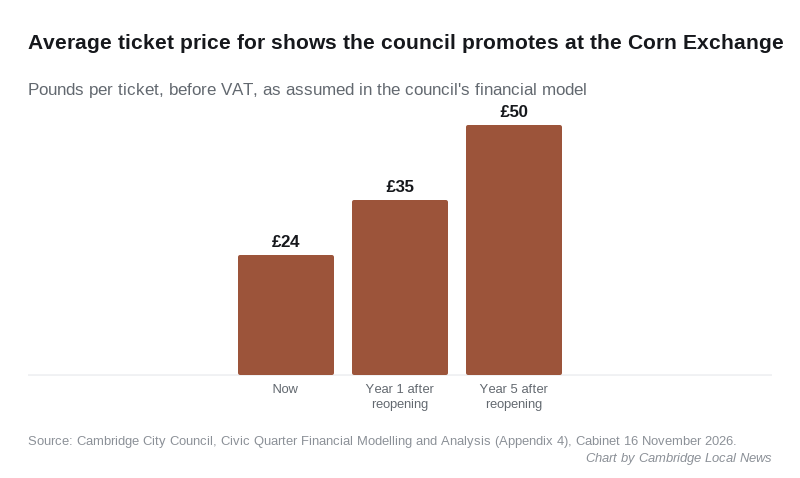
The council's model has the average Corn Exchange ticket rising from £24 to £50 before VAT by year five. Cabinet backed the £95.7m scheme on 16 November; Full Council votes on 26 November.
The average ticket for shows the city council puts on at the Cambridge Corn Exchange would more than double after the venue’s refurbishment, on the council’s own figures. Its financial model assumes the average price rises from £24 today to £50 by the fifth year after reopening. Both figures are before VAT.
Updated 20 November: Cabinet unanimously backed the full scheme on 16 November (our story). Full Council votes on the money on 26 November.
The assumption is in the financial modelling appendix to the Civic Quarter report. Cabinet is asked to back the full £95.7m scheme on Monday 16 November. Full Council would then need to approve the money on 26 November.
What the council’s model assumes
The figures were modelled by the council’s consultants, Blue Horizon. They cover the shows the council promotes itself and takes the box office from. For those, the model assumes:
- an average ticket price of £35 plus VAT in the first year after reopening
- rising to £50 plus VAT by year five, then 2% a year after that
- an average of 32.5 such shows a year
- average attendance of 1,268, up from around 800 now
At the standard 20% VAT rate, £24 is £28.80 to the customer and £50 is £60.
The model also adds charges on every ticket sold, whoever puts the show on:
| Charge per ticket, before VAT | On reopening | By year nine |
|---|---|---|
| Booking fee | £3.50 | £4.50 |
| Building levy | £1.50 | £2.00 |
The appendix calls the booking fee and levy “an important part of the Corn Exchange model”.
More shows from outside promoters
In the model, most shows are hires, where an outside promoter rents the hall and sets its own prices. The model does not give an average ticket price for those. It assumes hired shows grow from 153 in the first year to 210 by year five and 219 by year nine. Average attendance at hired shows rises from 871 to 1,081 over the same period.
The appendix says hire charges were first modelled higher, to reflect a high-quality refurbished venue. For prudence they were cut back to “a more standard industry benchmark”.
Why the income matters to the whole scheme
The Corn Exchange is the money-maker in the plan. The appendix says all four options for the Civic Quarter “rely heavily on future net income from the Corn Exchange”. That income is “predicated on a significant uplift in activity levels, ticket prices and associated charges”.
It names the risk plainly. If the targets cannot be met, for example in “a wider economic downturn”, that “could lead to a significant ongoing impact on the General Fund”, the budget that pays for day-to-day council services.
The council has tested what happens if the venue does worse. In its moderate downside case, attendances, show numbers and ticket prices are all 10% below the base case for the first five years. In the severe case, ticket prices start 10% lower and only rise by 2% a year.
The Cabinet report proposes a £4.8m reserve to absorb early losses and cushion “loss of income due to incorrect assumptions”. It also budgets for a venue consultant to help with the growth plan.
The council’s own warning on affordability
The council’s equality impact assessment for the Corn Exchange flags the same issue. It says “low-income individuals and families may be excluded if ticket prices rise post-renovation especially for premium events”. It adds that young people, older adults and disabled people on fixed or lower incomes “could face barriers to participation”.
It also warns that “if pricing structures favour commercial or high-end programming, it may reduce access to community-led or culturally diverse events”.
What the money buys
The Cabinet report calls the Corn Exchange “the largest music venue in the East of England”. It says the venue needs a new roof, better ventilation and temperature control, improved acoustics and better access. Planning permission for the work was granted in March 2026.
The accessibility changes listed in the report include:
- step-free access throughout the venue
- three lifts
- 15 spaces for wheelchair users in the main auditorium, with better sightlines
- an accessible dressing room and showers backstage
When it closes and reopens
The Cabinet report sets out the timetable if the scheme goes ahead:
| Date | What happens |
|---|---|
| 16 November 2026 | Cabinet decides |
| 26 November 2026 | Full Council votes on the capital budget |
| 31 December 2026 | Last show before closure |
| Mid-January 2027 | Venue cleared |
| Summer 2028 | Refurbishment due to finish |
There will be no temporary venue while it is shut. The council looked at a purpose-built one, including on Parker’s Piece, and at using other halls in the city. It concluded “the costs and risks outweighed the potential benefits”.
The report says 82 employees will be affected by the closure. Of those, 26 are salaried and 56 are on no-fixed-hours contracts. A consultation with staff and unions will follow the decision.
What it means for you
- Until 31 December the venue stays open; the report gives that date for the last show.
- After reopening, expect higher prices for the shows the council promotes itself if the model is followed, plus a per-ticket booking fee and building levy. These are planning assumptions, not a published price list.
- For about 18 months from January 2027 there will be no Corn Exchange shows in Cambridge. Our things to do in Cambridge page lists what is on at other venues.
- To have your say, you can contact your city councillor before the Cabinet meeting on 16 November. The agenda and papers are on the council’s meeting page.
The same report decides the future of the Guildhall. We set out the four options for the Guildhall and what each would cost.
Have your say