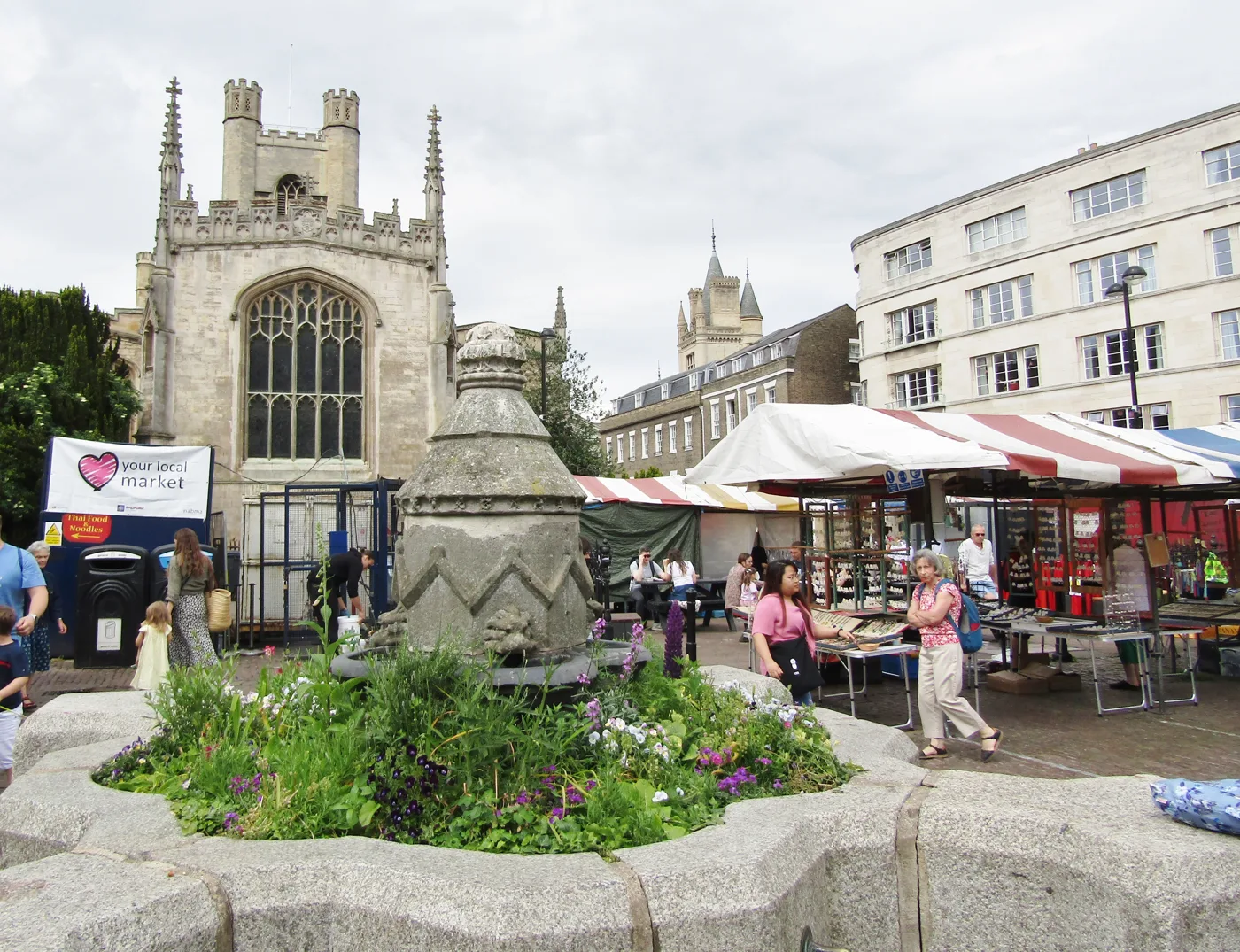

Councillors approved the Market Square overhaul on 2 September, but no security gate can be installed until its design is signed off. Highways still object.
Cambridge City Council’s planning committee approved the refurbishment of Market Square on Wednesday 2 September, five months after sending the same scheme away to be reworked.
Two applications went through: 25/04382/FUL and 25/04383/LBC, both approved as officers recommended, with the changes set out in the amendment sheet and agreed at committee.
The applicant is the council itself. The officer report records the applications as “submitted by a local authority for development on land it owns or controls”.
What was approved
The permission covers Market Square, Peas Hill and Guildhall Street. It includes:
- relaying and treating the Grade II listed setts, on a predominantly level surface
- new Yorkstone and granite sett paving
- replacement market stalls, a mix of permanent fixed stalls and demountable ones
- works to the listed fountain and railings
- new cycle parking, landscaping and street furniture
It forms part of the wider Civic Quarter project, which links the Guildhall, the Corn Exchange and the square.
The gates need a second decision
The four security gates on the north to south routes across the square were the sharpest point of argument, and they survived the redesign unchanged.
Officers were not persuaded by them. Their report says the applicant considers four gates safer, but that the case has not been made:
the information submitted to date does not demonstrate whether the maintaining permeability through the square supported by appropriate lighting, CCTV coverage and active management or closing access by way of the proposed gates would represent the preferable outcome from a community safety perspective.
Officers also asked whether the police architectural liaison officer supports them, and how much overnight storage the gated area is actually meant to provide. Neither question had been answered.
The result is condition 16. No security gate can be installed until the council has approved, in writing, the location, materials, design and colour of each one. The gates were let through only because officers judged that they “do not go to the heart of any permission”.
The county highway authority still objects
The scheme’s flush, shared surface remains unresolved. Cambridgeshire County Council, as local highway authority, objects, and its comments in the amendment sheet are blunt:
- the accessibility work does not justify removing conventional physical delineation, and the Department for Transport has paused shared surfaces
- Guide Dogs asked for a 60mm kerb upstand, and it has not been included
- Guide Dogs and CamSight both flagged cyclists, e-bikes and e-scooters as a risk, and the response relies on signage and talks with the rental operator
- the proposed 400mm strip of blister paving is below the average adult pace, given as 550mm to 650mm
- draft condition 20 is “unimplementable in its current form”
Officers disagreed. They concluded that low vehicle volumes reduce the relevance of the government guidance, and that traffic and pedestrian movements peak at different times of day. In the planning balance they attribute “a low additional risk to the safety of the public highway”.
Traders are still not on board
Lack of trader support was one of the six reasons the committee deferred the scheme on 25 March. It has not been fixed.
The officer report says plainly that “there is still a lack of support from the traders”, with concerns about the kiosks, the management plans, the costs and whether the design meets what traders actually need. Because those talks are still going on, no further detail about the demountable stalls has been submitted at all.
Officers’ answer was that costs and management plans are not planning matters, and that “it would be unreasonable to refuse a planning application solely on the basis of it receiving objection”.
What changed after March
The committee deferred the scheme on 25 March for six reasons: highways and road safety including a missing road safety audit, the loss of cycle spaces, no time to review the new setts, the lack of trader support, over-reliance on conditions, and missing detail on the demountable stalls.
The reworked scheme brought a road safety audit, an independent accessibility statement, an addendum to the transport statement and amended drawings. The visible changes include:
- traffic on the Market Hill loop stays clockwise, reversing the proposed direction
- the carriageway will be granite setts rather than Yorkstone
- an 800mm strip of directional tactile Yorkstone paving runs along the carriageway edge
- 12 new open-sided permanent stalls replace 10 demountable stalls in the centre of the square
- 60mm kerb upstands go into the servicing areas on Peas Hill and Guildhall Street
- four trees come out, two by the Guildhall and two on the market side of Peas Hill
Cycle parking
The county’s active travel officer raised no objection, noting 110 spaces inside the application boundary and another 76 within 35 metres of it, plus 12 spaces sized for cargo bikes.
Camcycle objected anyway. It welcomed the cargo bike spaces and the Sheffield stands, but argued that simply holding existing levels is not enough for a space like this, and that the 76 off-site spaces were not secured. Officers accepted a condition requiring replacement parking to be in place, temporary if necessary, before any existing stands are removed.
Inside the red line there is still a net loss of spaces, mostly from removing the stands along Peas Hill.
The fountain stays dry
The scheme does not bring the listed fountain back into working use. Historic England and the council’s own conservation officers say that has not been justified, and officers accept it offers no heritage benefit, though they judge that the works cause the fountain no harm.
On the setts, officers found a high level of harm to the listed surface, largely from sawing them and relaying them in cement mortar. They rate the harm to the setting of the listed structures on the square and to the Historic Core Conservation Area as moderate, and the harm to nearby listed buildings as low. All of it is “less than substantial”, so it falls to be weighed against public benefits, which officers concluded win.
What it means for you
The market keeps trading, somewhere. A separate planning application, 26/03254/FUL, would put temporary stalls on King’s Parade, St Mary’s Passage, Market Hill, Petty Cury, Fisher Square, Sussex Street and Sidney Street while the square is dug up. It was still in validation when the committee papers were written, so nothing about the temporary market is settled.
Nothing starts tomorrow. The permission has the standard three years to be begun, and several conditions have to be discharged first, including the gates, the demountable stalls, a wayfinding strategy and a landscaping scheme.
Events at the Guildhall get a time limit. The condition on the open-air events space in front of the Guildhall restricts use, including setting up and taking down, to between 7am and 11pm, and requires a noise management strategy first.
If you cycle in, expect the stands to move. Parking along Peas Hill goes, replacement stands appear just outside the site, and there will be 12 spaces built for cargo bikes.
Also decided that day
The committee approved 25/04484/FUL at 87 to 93 Oxford Road and the Fitzwilliam College sports ground. It deferred four items: the University sports and athletics track on Wilberforce Road, 23 to 27 Kings Hedges Road, and both applications at 49 New Square.
More decisions as they land are on Cambridge planning, and roadworks around the city centre are on Cambridge roadworks and travel.
Sources
- Planning committee decisions, 2 September 2026, Cambridge City Council, for the approvals and deferrals.
- Officer addendum report, 25/04382/FUL, for the deferral reasons, the changes made since March, the gates assessment, the heritage harm, the cycle parking and the planning balance.
- Amendment sheet, 2 September 2026, for the county highway authority and active travel comments, the Camcycle objection, the temporary market application reference and the amended conditions.
- Planning committee papers, 2 September 2026, Cambridge City Council, for the full agenda and appendices.
Have your say