
Cambridge takes £20m of a £22m government package to grow organoids from NHS patients' cells and test drugs without animals. Who is in it, and what it will do.
A £20 million national research hub that will grow miniature human organs from cells donated by NHS patients is to be run from the Cambridge Biomedical Campus. It takes almost all of a £22 million government package announced on Wednesday 12 August, the rest of which is split between nine much smaller projects elsewhere in the country. (Department for Business, Innovation, Science and Trade)
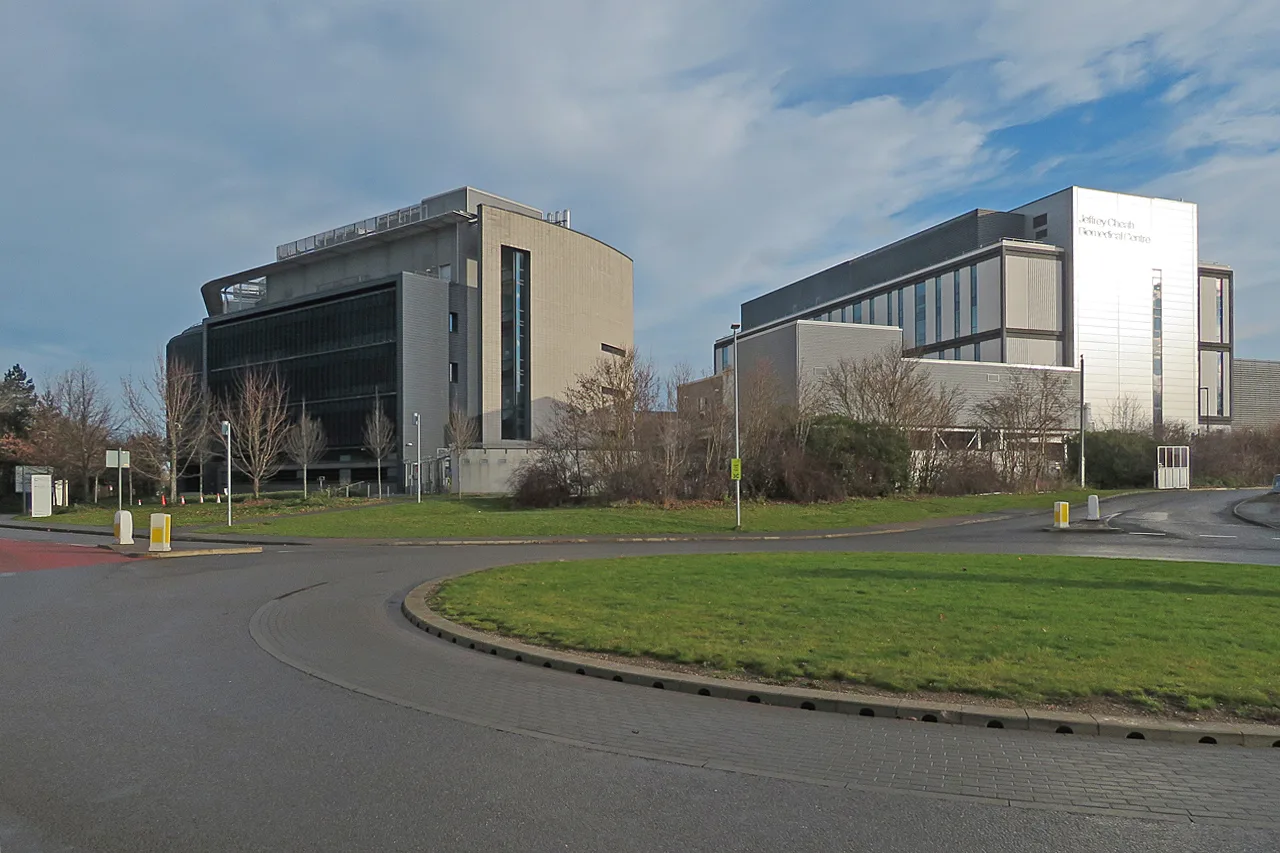
The Pre-clinical Translational Models Hub will be led from the Cambridge Stem Cell Institute, inside the Jeffrey Cheah Biomedical Centre on the Biomedical Campus, and funded by the Medical Research Council. The money runs for 42 months and the award has to start by 14 November 2026. (UKRI)
What it will actually do
The hub’s subject is the organoid: a small, simplified version of a human gut, tumour or brain, grown in a laboratory from a patient’s own donated cells. Because those tissues keep features of the individual patient’s biology, researchers can watch a disease behave and test a candidate drug on human tissue rather than inferring the answer from an animal.
The point is that a great many drugs fail at exactly that step. As the University put it, the current process relies heavily on animal models, and many treatments that look promising in animals fail when they reach humans, which costs years of work and the investment behind it. (University of Cambridge)
The hub is meant to combine those human tissue models with AI, bioengineering and clinical research, and then to open the result up. Under the terms of the funding it has to work as a national resource, giving researchers, the NHS and companies across the UK access to the technology and to patient samples, and to build AI tools for identifying and validating drug targets.
Professor Matthias Zilbauer, who will direct the hub and leads a group at the Cambridge Stem Cell Institute, said patient-derived organoids allow researchers “to understand disease more accurately and test potential treatments before they ever reach the clinic”, with the potential to cut the time and cost of developing new medicines.
Professor Bertie Göttgens, the institute’s director and the hub’s co-director, said the aim is to accelerate the next generation of human disease models with academic, NHS and industry partners.
Who is in it
The hub is a Cambridge cluster rather than a single building’s project. Alongside the Cambridge Stem Cell Institute, the named partners are Cambridge University Hospitals, Royal Papworth Hospital, the Wellcome Sanger Institute and the MRC Laboratory of Molecular Biology. The Biomedical Campus site also puts it next to AstraZeneca’s Discovery Centre and GSK’s clinical unit. (Cambridge University Hospitals)
That concentration is the reason the money landed here. Everything the hub needs sits within a few miles of the same site: the hospitals whose patients donate the tissue, the laboratories that grow it, the sequencing capacity at Hinxton, and the drug companies that would be the eventual customers for the results.
Where the £22 million goes
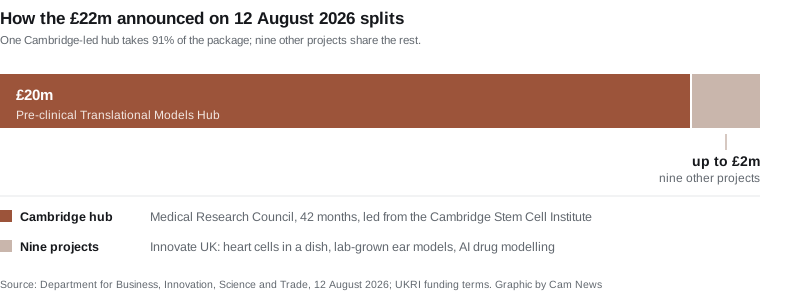
The Cambridge hub is 91% of the money announced that day. The other nine projects are funded by Innovate UK and share up to £2 million between them. They include beating heart cells grown in a dish, lab-grown models of the human ear, and AI that predicts how a medicine moves through the body. The government says many of them target the safety studies that still use dogs and monkeys.
The wider context is a decline that is already under way but slow. There were 2.54 million animal testing procedures in Great Britain in 2025, down 3.8% on 2024. The hub itself will not run animal experiments, though its models may be checked against existing animal data to validate them, and it is required to monitor and report how its work contributes to reducing animal use in science.
Science minister Chris McDonald said the funding gives researchers “the tools they need to deliver more effective treatments”, and described it as a boost for a life sciences sector the government puts at around £147 billion of turnover and some 360,000 jobs nationally.
What it means for you
Be clear about what this is and is not. It is research funding, not a new treatment and not a new hospital service. Nobody will be treated by this hub. Its output is a better laboratory method for deciding which drugs are worth taking into trials, and the earliest that could show up in a Cambridge clinic is years away.
What is concrete locally is smaller and nearer. The award runs for 42 months from this autumn and is held by an institute on the Biomedical Campus, so it is skilled research work on a site that already employs a large share of the city and continues to grow. If you are an Addenbrooke’s or Royal Papworth patient, the hub depends on donated human tissue, which is what “grown from NHS patients” in the announcement means in practice: samples given with consent, through the hospitals, under the usual research governance.
The campus keeps expanding, and what it builds next shows up in the planning register before it shows up anywhere else. We track that in our Cambridge planning news.
Have your say