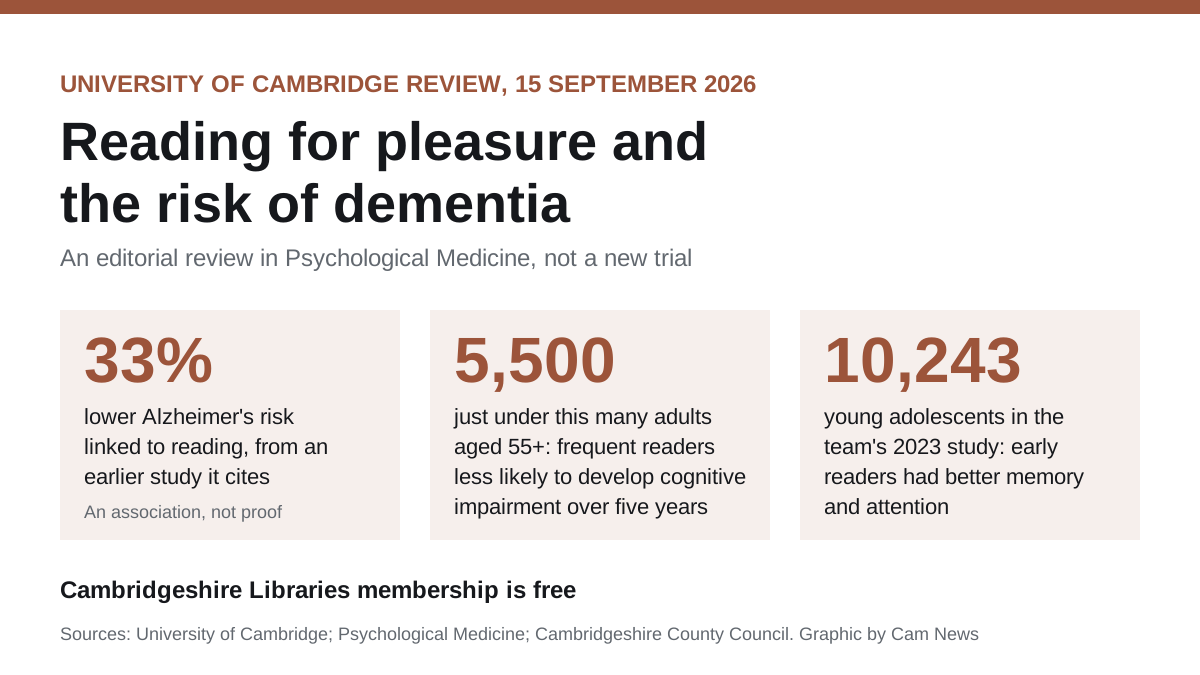

A Cambridge review links reading for pleasure to lower dementia risk. The one-third figure comes from an earlier Alzheimer's study and shows a link, not proof.
Two psychiatrists at the University of Cambridge say reading for pleasure is linked to better mental health, greater empathy and a lower risk of dementia. Their paper was published on 15 September in the journal Psychological Medicine.
It has been reported widely as a Cambridge study that found reading cuts dementia risk by a third. That is not quite what the paper is. It is an editorial review of other research, and the one-third figure comes from an earlier study it cites.
Who wrote it
The authors are Professor Barbara Sahakian and Dr Christelle Langley of the Department of Psychiatry, with Vicki Perrin, chief executive of The Queen’s Reading Room. The university describes that charity as founded by Her Majesty The Queen. The scientists say they joined with it to highlight reading as part of the National Year of Reading.
The journal describes the paper as an editorial that draws on “subjective surveys and objective studies using longitudinal, neuroimaging, and behavioral methods”. Sahakian and Langley started looking at the subject while writing their 2025 book, Brain Boost: Healthy Habits for a Happier Life. The university says they found “surprisingly little research in this area”.
What it says about dementia
The review points to two earlier findings in older adults. Both are set out in the university’s announcement:
- In a study of almost 5,500 adults aged 55 and over, people who often took part in activities including reading were significantly less likely to develop cognitive impairment over five years.
- A separate study found that reading newspapers, magazines and books was associated with a 33% lower risk of Alzheimer’s disease.
The second study is the source of the “a third” headlines. It measured Alzheimer’s disease, which is the most common form of dementia but not all of it.
The authors are careful about cause and effect. The university’s release says “most studies only show associations”, although it adds that “evidence is emerging of a causal link”. The journal abstract uses the same language: reading is “associated with” a lower risk of dementia and slower cognitive decline, “even among individuals with lower educational attainment”.
Professor Sahakian said book clubs may add something on top. “Shared reading groups and book clubs appear to provide additional benefits through social interaction,” she said. “They can help people feel less isolated and more connected to others, which has been shown to reduce the risk of dementia.”
What it says about children and adults
The strongest evidence in the review comes from the authors’ own earlier work. In 2023 the same Cambridge team published a study of 10,243 young adolescents in the US, drawn from the Adolescent Brain and Cognitive Development cohort. Children who began reading for pleasure early showed:
- better attention, memory and executive function
- higher academic achievement
- fewer mental health problems
- more sleep and less screen time
For adults, the review leans mostly on surveys. The figures the university highlights are:
| Finding | Where it comes from |
|---|---|
| 38% of adults choose books as their ultimate way to unwind | Survey data |
| Five minutes of fiction can cut stress by up to 20% | 2024 study commissioned by The Queen’s Reading Room |
| 35% turn to books for comfort, against 31% for wine and 10% for a hot bath | Survey |
Dr Langley said the aim with children is to “find something they’d really enjoy reading about”. She suggested comics and graphic novels “might be seen as less intimidating, maybe less boring, than novels”.
What it means for you
If you want to act on it, the review’s message is that it does not matter much what you read, and reading with other people may help more. In Cambridge and the county, the free routes are all run by the county council:
- Library membership is free. You can join Cambridgeshire Libraries online as an e-member, which lets you borrow two books at a time. Take proof of address to any library for full membership.
- Reading groups. Some libraries run groups that meet in the library and take new members. Ask at your local branch. A group can also buy a reading group card, at £35 a year shared between members, to borrow sets of the same book.
- Online. The same council page lists The Really Popular Book Club, Cambridge University Libraries’ online book club, which it says is open to everyone.
- If getting to a library is hard. The Library at Home service is free. A volunteer visits once a month with books chosen for the reader. It is open to residents of any age with a disability, illness or caring responsibilities. Call 0345 045 5225 or email volunteers@cambridgeshire.gov.uk.
For more ideas on getting out in the city, see our things to do in Cambridge page.
Sources
- University of Cambridge press release, via EurekAlert
- Sahakian BJ, Perrin V and Langley C, Reading and associations with brain health, cognition, well-being, and mental health, Psychological Medicine, 15 September 2026
- University of Cambridge, 2023 study of reading in early childhood
- Cambridgeshire County Council, library membership, reading groups and Library at Home
Have your say