
Cambridge's hosepipe ban has run since 17 July, the first in over 30 years. The new Local Plan wants water reuse on big schemes, but the law bars piping it indoors.
Cambridge Water’s hosepipe restriction has now been in force for more than five weeks, and the company says it cannot say when it ends. It became enforceable at 1am on Friday 17 July, and it is the first time the company has had to impose one in over 30 years. (Cambridge Water)
A planning policy open for comment right now proposes an answer for the homes still to be built. It is to stop using drinking water for jobs that do not need drinking water.
The catch is that the law does not currently allow a water company to deliver that.
What the new Local Plan asks for
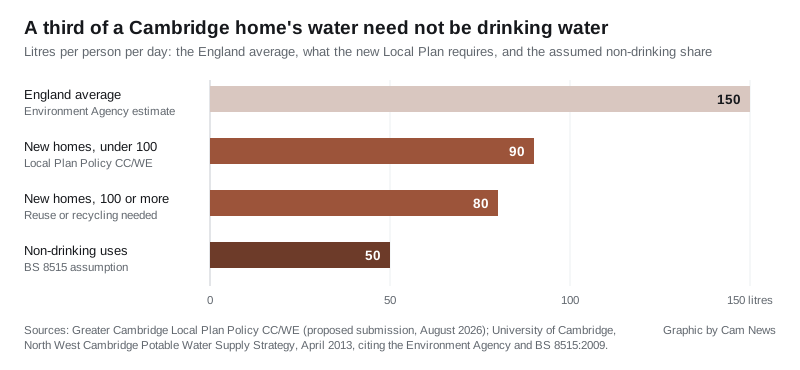
Policy CC/WE of the Greater Cambridge Local Plan sets water use limits for every new building. For housing schemes of 100 dwellings or more it requires “water usage of no more than 80 litres/person/day”, and then says plainly: “To achieve this level, some form of water reuse or recycling will be necessary.” (Greater Cambridge Shared Planning)
The rest of the policy sets:
- 90 litres per person per day for housing schemes of fewer than 100 dwellings
- at least 4 BREEAM Wat 01 credits, or a 60% cut in water use, for non-residential schemes
- a smart water meter in every new dwelling, including every flat in a block
- a water butt on every new home with private outdoor space
- no water-based cooling for data centres, which must use closed-loop systems and additional sources such as rainwater and grey water
The consultation on the plan closes at 5pm on 25 September 2026.
The supporting text explains why the councils are asking. Greater Cambridge is one of the driest parts of the UK. Cambridge Water’s supply zone is classed as an area of “serious water stress” by the Environment Agency. Water is drawn from the chalk aquifer, and the Environment Agency is cutting abstraction licences to stop further damage to the rare chalk streams.
The two big new sources of supply are years away:
- a pipeline bringing water in from Grafham Water, anticipated by 2032
- the Fens Reservoir, a joint scheme with Anglian Water, by 2036
The government has also set up a Water Scarcity Group for the area.
The councils also name the technology they have in mind. Water recycling, the plan says, could “include systems that recycle rainwater, stormwater, greywater or foul water and use dual pipe systems for potable and non-potable water”.
Why a dual pipe system is not currently lawful
Five months before that consultation opened, the government’s own drinking water regulator published its verdict on exactly this idea.
The Drinking Water Inspectorate released its report “Governance framework for rainwater harvesting and greywater reuse systems” on 17 March 2026. Its fourth recommendation is to “review and update primary and secondary legislation to enable adoption and effective regulation of dual pipe systems”. The justification is one sentence long: “There is no definition or allowance for the supply of non-drinking water in primary legislation.” (Drinking Water Inspectorate)
The report sets out how two pieces of law combine to produce that result:
- Section 218 of the Water Industry Act 1991 defines “domestic purposes” broadly. It covers drinking, washing, cooking, central heating and sanitary purposes, and explicitly includes washing vehicles and watering gardens.
- Regulation 4 of the Water Supply (Water Quality) Regulations 2016 requires water supplied for those purposes to be wholesome, which in practice means of drinking quality.
So the same rule that guarantees the water in a Cambridge kitchen tap is safe also applies to the water in the cistern behind the toilet. The DWI notes the contrast with private water supplies, where the regulations do allow water that is not wholesome for some uses.
The Inspectorate’s expert group went on to divide domestic uses in two. It judged these unsuitable for non-drinking water on health grounds:
- drinking and food preparation
- washing, showering, bathing and teeth brushing
- washing dishes
- outdoor hot tubs and paddling pools
And these suitable, on the basis of low risk to the user and large volumes:
- toilet flushing
- garden irrigation of lawns and non-edible plants
- car washing, pressure washing patios and drives, and other outside uses
The report is a set of recommendations, not a change in the law. It also asks for a further piece of work, under Recommendation 10, to establish water quality standards for non-drinking water, noting that the World Health Organization publishes no guideline values for it.
Six days after the report came out, Defra was asked in Parliament what it was doing to promote recycled water. The environment minister Emma Hardy replied on 23 March. She said the government’s Water White Paper “committed to facilitating the adoption of reused water and review the right to connect to water supply”. Greywater and rainwater reuse were also being considered in a review of the Building Regulations. She gave no date for either. (UK Parliament, written question 121684)
Cambridge already built one
The city has a site designed around exactly this. Eddington, the University of Cambridge’s development in north west Cambridge, was planned from the start to run two water networks.
The University’s own North West Cambridge Potable Water Supply Strategy, dated April 2013, is explicit about the arithmetic. A predicted population of 10,809 people would need 1,621,350 litres of drinking water a day at conventional consumption rates. Getting to 80 litres per person per day, the Code for Sustainable Homes Level 5 standard the development committed to, cuts that to 864,720 litres. The document states that the reduction “requires some water recycling onsite to generate a supply of non-potable water for the development”.
Under that strategy, surface water runoff would be captured across the site, treated, and redistributed through a separate non-potable network. The document says that network “will be adopted and maintained by Cambridge Water”. (University of Cambridge)
The scale of the prize is in the same document. British Standard BS 8515:2009 assumes a non-drinking demand of 50 litres per person per day, which across Eddington’s projected population comes to 540,450 litres a day.
We could not find any public document that records whether that network is now supplying Eddington homes. Cambridge Water’s regional water resources plan mentions the site only in passing. The company says it is “exploring water recycling to see how the cost of these schemes can be reduced”, and that this is “based on our experience of the Eddington site”. (Cambridge Water) Neither the company nor the University publishes an operating status for the non-potable network, and we are not repeating a figure we cannot source.
There is one more line worth reading in the meantime. Cambridge Water’s own hosepipe ban FAQ tells customers that a garden irrigation system “may be used when connected to a grey water or rainwater recycling system (i.e. not attached to the mains system)”. Recycled rainwater on a Cambridge garden is fine. It is the pipe from the water company that the law objects to.
What it means for you
The restriction is still on. Cambridge Water says it cannot say how long the restrictions will last, and that they “will need to be in place until we receive prolonged significant rainfall, and our groundwater levels return” to a normal position.
The penalty is real but rarely reached. Under the Water Industry Act 1991 anyone who fails to comply can be prosecuted and fined up to £1,000 by a magistrates’ court. Cambridge Water says prosecution would generally only be considered where customers continue to ignore requests to comply after informal approaches.
Rainwater is exempt, and so is anything off the mains. The company’s FAQ says the restrictions “apply only to the clean, potable water provided by Cambridge Water”. A water butt, a greywater system or a drip-fed irrigation system off the mains is unaffected. Bowling greens, golf courses and public pools are covered by the ban, with a narrow exemption for sports surfaces.
It applies even if another company bills you. Households in the Cambridge Water region supplied by Independent Water Networks, ESP Utilities Group or Leep Networks are covered too, because Cambridge Water supplies the water to them.
If you want the reuse rules changed or kept, say so by 25 September. Policy CC/WE is part of the proposed submission Local Plan. Comments must reach Greater Cambridge Shared Planning by 5pm on 25 September 2026. The plan will govern what gets built in the city until 2045. Our running summary of local decisions is on the Cambridge planning news page.
Water is now a condition on planning permission. The policy states that planning conditions “will be used to secure the proper implementation, management and maintenance of water recycling systems”. Cambridge Water has also been applying an enhanced assessment of new connection requests since April 2025. Anyone buying a new-build in the city should expect a smart water meter as standard.
Have your say