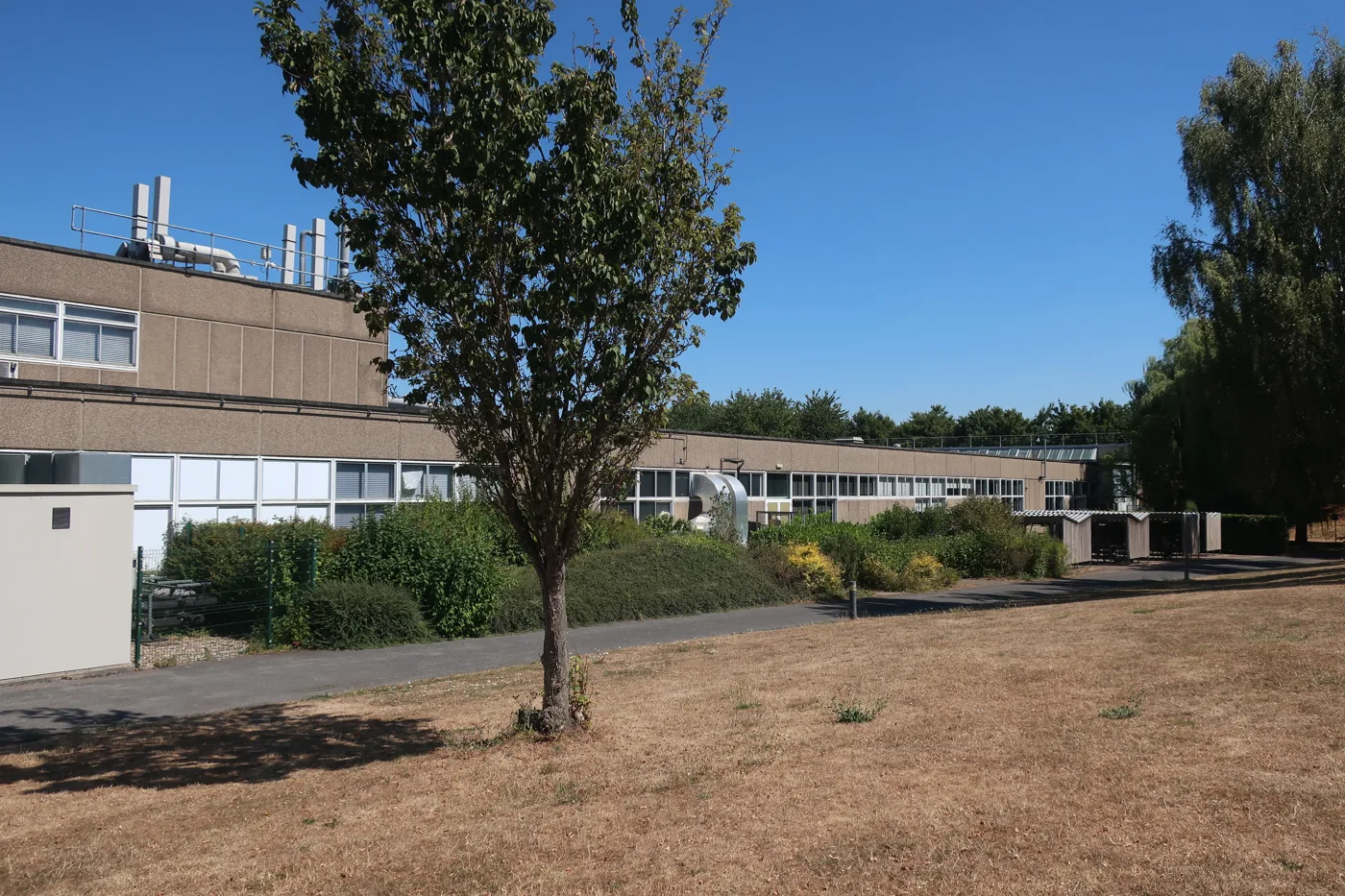

Six Cavendish Laboratory buildings at West Cambridge can be demolished from 24 August, after a decision issued on 19 August. Work runs to November 2027.
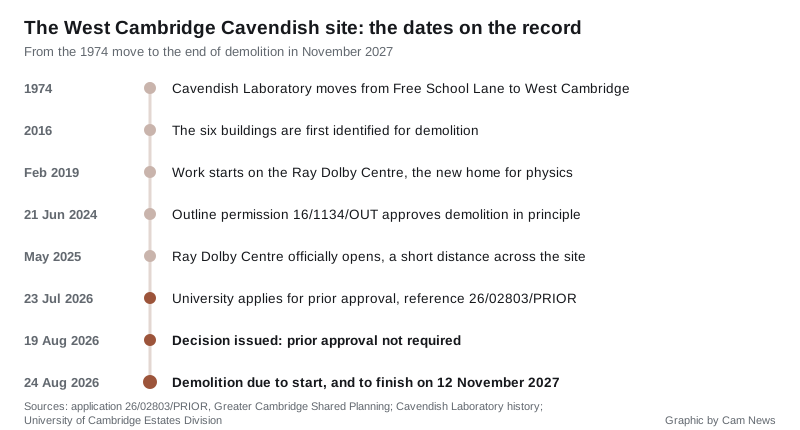
The six buildings that housed Cambridge physics for half a century can now come down. Greater Cambridge Shared Planning issued its decision on Wednesday 19 August, under reference 26/02803/PRIOR. The University of Cambridge told the council it expects demolition to begin on Monday 24 August and to finish on 12 November 2027. (Greater Cambridge Shared Planning)
The site sits in the south eastern corner of the Cambridge West site, off Madingley Road. The register address is Cavendish Laboratory, 19 J J Thomson Avenue, CB3 0HE. The Coton footpath and cycle route runs along its southern edge.
The application covers six buildings, plus assorted ancillary structures and hardstanding:
- Mott Building
- Bragg Building
- Link Building
- Rutherford Building
- Microelectronics Research Centre
- Kapitza Building
What the council actually decided
This was not a planning application in the usual sense. It was submitted under Schedule 2, Part 11, Class B of the General Permitted Development Order, which already allows demolition of this kind. The council’s only job was to decide whether it needed to approve two things: the method of demolition, and how the site is put back afterwards.
Officers decided it did not. The delegated report concludes that the proposal meets every criterion in Class B, and the decision reads “Prior Approval not required”. The buildings are not listed, they are not in a conservation area, and none of the protected categories in the legislation applies.
So the question of whether the buildings should go was never on the table here. That was settled in 2024. Outline permission 16/1134/OUT for the wider Cambridge West site, granted on 21 June 2024, already approved their demolition. It covers up to 383,300 square metres of development, of which up to 370,000 square metres is academic floorspace and no more than 170,000 square metres commercial. That permission has not yet discharged its strategic pre-commencement conditions, which is why a standalone prior approval was needed first.
No third party made a representation on the application. Cambridgeshire County Council’s highways team raised no objection, and neither did Cadent Gas. The council’s environmental health team also had no objections, while stating that it expects the measures in the demolition environmental management plan to be applied throughout.
How they will be taken down
The University’s method statement sets out a phased, top-down demolition. In order:
- asbestos removal, internal soft strip and isolation of services
- structural demolition using high-reach excavators and conventional plant
- buildings taken down one after another, each to ground level
- materials segregated on site for recycling and recovery where practicable
- dust, noise and vibration controlled with suppression and monitoring throughout
Rubble will be processed on site where it is suitable, which the University says will cut the number of lorry movements. Anything left over goes to a licensed waste facility. Nothing is to be stockpiled on the site once the work is done.
What is left behind
The finished site will be flat and level, covered in imported topsoil and seeded with grass. The University footpath that crosses the site has to be removed to allow the demolition, and will be reinstated afterwards. A timber knee rail will go round the perimeter to keep vehicles out.
None of the trees on the site is covered by a Tree Preservation Order. The University says trees will be kept unless removing them is needed to carry out the demolition. Protection will be put in place for those that stay, including the woodland belt at the edge of the site.
After that, the land is expected to sit in a holding state for some time. The supporting statement says the University is likely to bring forward a “meanwhile” use through a separate application. The permanent replacement, further academic and commercial buildings under the Cambridge West masterplan, is described as coming forward over the next 20 years.
Why the buildings are going
The Cavendish moved out to West Cambridge in 1974, leaving the cramped Free School Lane and New Museums site it had occupied for a century. Brian Pippard, the Cavendish Professor at the time, ran the move. (Cavendish Laboratory)
Physics has now moved again, this time only a short distance across the same site. The Ray Dolby Centre cost £303 million and provides 32,900 square metres of floorspace. Construction started in February 2019 and completed in May 2024, with the official opening in May 2025. The building is named in recognition of an £85 million gift from the estate of the sound engineer Ray Dolby. (University of Cambridge Estates Division)
On the application form, the University states that the old buildings “have reached far beyond their design life” and are “not fit for repurposing or conversion”. The supporting statement notes they were first identified for demolition as far back as 2016.
What it means for you
If you use the Cambridge West site, the footpath across the demolition area is the practical change. It goes, and it comes back at the end. Expect the site to be fenced from next week.
If you live nearby, the noise and lorry movements are the thing to watch, and the route for complaints is environmental health at Cambridge City Council rather than the planning service. The permission has no conditions attached, because prior approval was not required, so the controls that apply are the ones in the University’s own demolition environmental management plan. Environmental health said plainly that it expects those measures to be applied for the whole of the works.
The University held a drop-in session for people who use the Cambridge West site. Its contractor also presented the demolition method and key timings to the West Cambridge Community Group, which includes local residents’ groups and councillors. The supporting statement says further sessions are planned periodically as the work goes on.
One date is worth keeping. The demolition is scheduled to run for almost 15 months, to 12 November 2027. Nothing permanent replaces these buildings for years after that.
Sources
- Application 26/02803/PRIOR, Greater Cambridge Shared Planning register, decision issued 19 August 2026. The delegated report, decision notice, application form and supporting statement are on the documents tab.
- Our history, Cavendish Laboratory, University of Cambridge
- Ray Dolby Centre, University of Cambridge Estates Division
We follow city applications week by week on our Cambridge planning news page.
Have your say