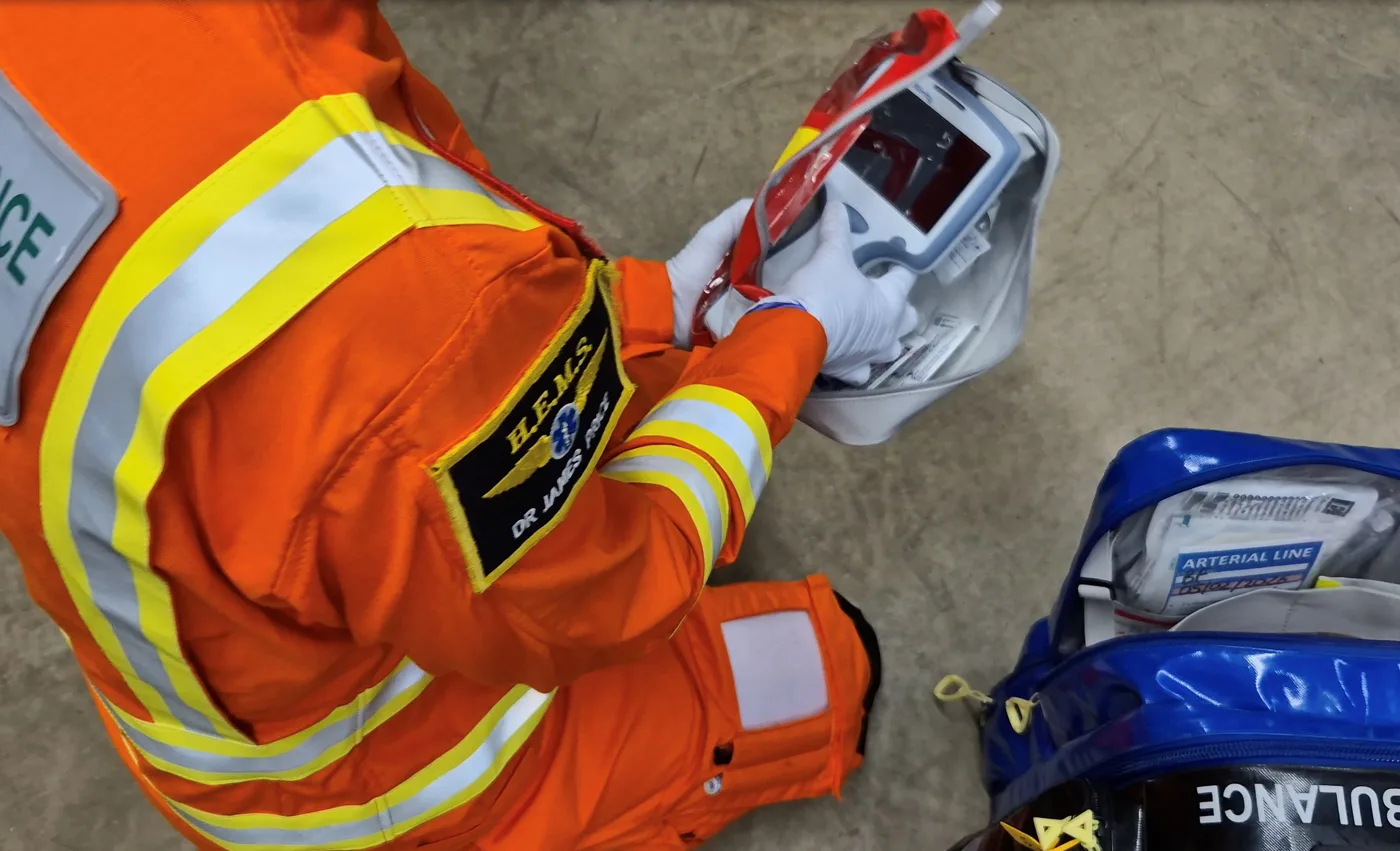

A handheld blood test identified every brain bleed among 65 coma patients, East Anglian Air Ambulance says, giving crews a result in minutes at the scene.
A blood test carried to emergencies by East Anglian Air Ambulance picked out every patient with bleeding on the brain in its first study, the charity says. Doctors and paramedics get the result in minutes, at the patient’s side, rather than waiting for a CT scan at hospital.
The study covered 65 patients in a non-traumatic coma, tested between January 2025 and April 2026. According to the charity, the test “correctly identified every instance of an intracranial haemorrhage that occurred, without missing a single case”. Its crews have since used the test on more than 200 patients with suspected serious brain injury.
The charity’s release does not say how many of the 65 had a bleed, or how often the test pointed to a bleed that was not there, and it does not link to the published paper. Those numbers decide how far a result like this can be relied on.
What the test does
The programme is called BRAIN-FIRST, and East Anglian Air Ambulance describes it as a UK first for air ambulances. Crews take a small blood sample and run it through a handheld analyser, the i-STAT Alinity, made by Abbott Point of Care. It measures two biomarkers, GFAP and UCH-L1, which are released into the bloodstream when cells in the brain are injured.
Until now, the charity says, crews have largely had to judge the risk of a bleed from a patient’s history, a physical examination and clinical signs. A definitive diagnosis usually needs a CT scan.
Dr James Price, a HEMS consultant and the charity’s clinical lead for research and development, said:
“BRAIN-FIRST represents a major step forward in pre-hospital emergency medicine. For the first time, we can obtain biological information about possible brain injury while we are still at the patient’s side.
“Our first published results are extremely encouraging. Earlier identification of patients at high risk of a serious bleed on the brain has the potential to reduce delays to specialist treatment, avoid unnecessary secondary transfers between hospitals, and help ensure patients reach the right care, in the right place, as quickly as possible.”
Why the hospital matters
The charity’s case goes beyond the diagnosis itself. A patient with a suspected bleed may first be taken to a hospital with no specialist neurosurgery, then need moving to a major neuroscience centre. Knowing the risk at the scene could help crews choose the right destination from the start, and judge how urgently specialist care is needed.
The project’s cartridges were paid for by Abel Homes, which the charity describes as a long-term supporter. Dr Price said:
“These projects would not be possible without philanthropic support. BRAIN-FIRST was made possible through the generous funding and support of Tony and Maggie Abel from Abel Homes, and we are enormously grateful for their commitment to improving care for patients with serious brain injury.”
What happens next
East Anglian Air Ambulance is working with other ambulance services in the UK and abroad to test the approach on a larger and more varied group of patients. It is also developing BRAIN-FIRST2, which will look at combining the biomarkers with clinical information to support more personalised decisions before a patient reaches hospital.
The programme is shortlisted for Innovation of the Year at the Air Ambulance UK Awards of Excellence 2026, which take place on Thursday 3 December at Telford International Centre.
The charity’s Cambridge base has to move
The results arrive as the charity tries to replace its Cambridge base. Its appeal page, which we read on 4 November, says Cambridge City Airport will close by 2030, after 19 years of support from its owners, Marshall. The new base, on the outskirts of Cambridge, will cost £14 million including the land. Part of that has already come from supporters, major donors and charitable trusts, and the charity is asking the public for the remaining £8.2 million. The page does not give a total raised so far.
The charity’s other base, in Norwich, is secure. It says that without a Cambridge base the Norwich crew would have to cover Bedfordshire, Cambridgeshire, Norfolk and Suffolk alone. It says that could mean over 600 fewer missions a year in Norfolk, 250 fewer in Suffolk and 62 fewer in Bedfordshire, with hundreds of people waiting longer for help.
The charity’s Cambridge carol concert is on 7 December at Great St Mary’s, one of the dates in our guide to Cambridge carol concerts.
Have your say