
Nissan will test a self-driving Leaf on Cambridge roads in a £3m government-backed project. No start date or route yet; here is what the plan does say.
Nissan will test a self-driving car on public roads in Cambridge. The carmaker announced the £3 million research project, called ADventure, in a release on its UK newsroom dated 27 September. The Greater Cambridge Partnership, which is supporting it, published the same release on 28 September.
The aim is a passenger service rather than a new car. Nissan says the project will study how a self-driving service could work alongside existing transport, with Cambridge as its first real-world trial. The company gives one example of a journey it has in mind: taking someone who does not drive to a medical appointment.
What the project is
According to Nissan’s release:
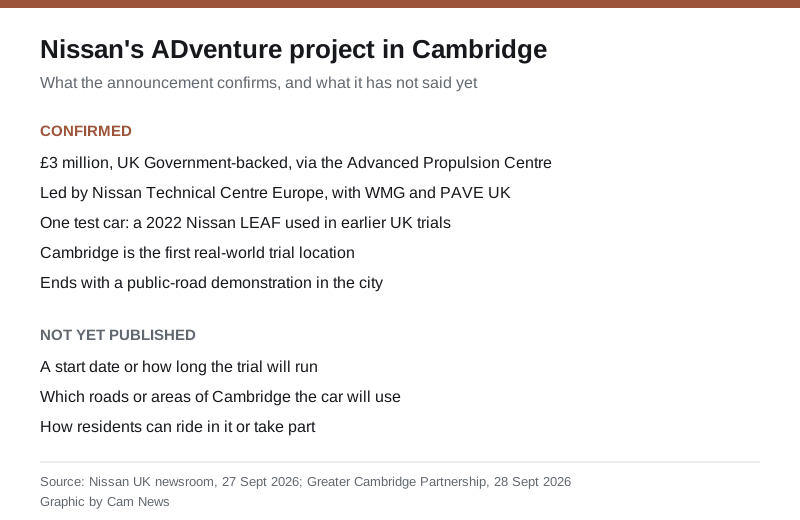
- it is led by engineers at Nissan Technical Centre Europe, from Cranfield in Bedfordshire, about 35 miles west
- the partners are WMG at the University of Warwick and PAVE UK, a group that explains automated vehicles to the public
- it is worth £3 million and backed by the UK Government, delivered through the Advanced Propulsion Centre in partnership with Innovate UK
- it uses one test car, a 2022 Nissan LEAF fitted with Nissan’s own driving system and already used in earlier UK trials
- it will end with a public-road demonstration in Cambridge
The release lists three areas of work. The first is designing a service around the city’s needs and its existing transport. The second is finding out what passengers need to feel informed and comfortable. The third is testing how the system performs on public roads.
Nissan says Cambridge was chosen after “a rigorous scoping process”, because the city has already hosted several self-driving projects. The car builds on Nissan’s earlier UK trials, HumanDrive, ServCity and evolvAD.
What has not been announced
The release does not give a start date or say how long the trial will last. It does not name any roads, neighbourhoods or destinations in Cambridge. It does not say whether members of the public will be able to ride in the car, or whether a safety driver will be on board.
It does say that local people will “play a central role”. The project will work “alongside local authorities, commuters and residents”. No way to sign up or give views has been published yet by Nissan or the partnership.
What the council partnership said
Cllr Brian Milnes, who chairs the Greater Cambridge Partnership, said in the release:
“We’re pleased to be supporting Nissan with their research project and helping them on their autonomous technology journey.”
He added that the partnership was looking forward to “exploring the benefits to communities and boosting local transport”.
How it fits with the self-driving buses
This is separate from the partnership’s own self-driving bus programme. In August the partnership won £3.88 million to extend its Connector trials. Self-driving Connector buses already run on routes serving:
- Cambridge West and Eddington
- the Cambridge Biomedical Campus
The partnership said a trial on the southern section of the Guided Busway was set to take place this year. Nissan’s project differs in scale and shape: one car, aimed at door-to-door trips rather than a fixed bus route.
What it means for you
Nothing changes on the roads yet. There is no published date for the car to appear, and no route. When it does, it will be a single, clearly branded test car, not a fleet.
If you rely on lifts or taxis to reach appointments, this is the use Nissan has singled out, and the project says it wants residents’ input. We will report how to take part once Nissan or the partnership publishes it.
For the bus routes and busway plans that are already approved, see our report on the Cambourne to Cambridge busway, and our roadworks and travel page for what is closed this week.
Have your say