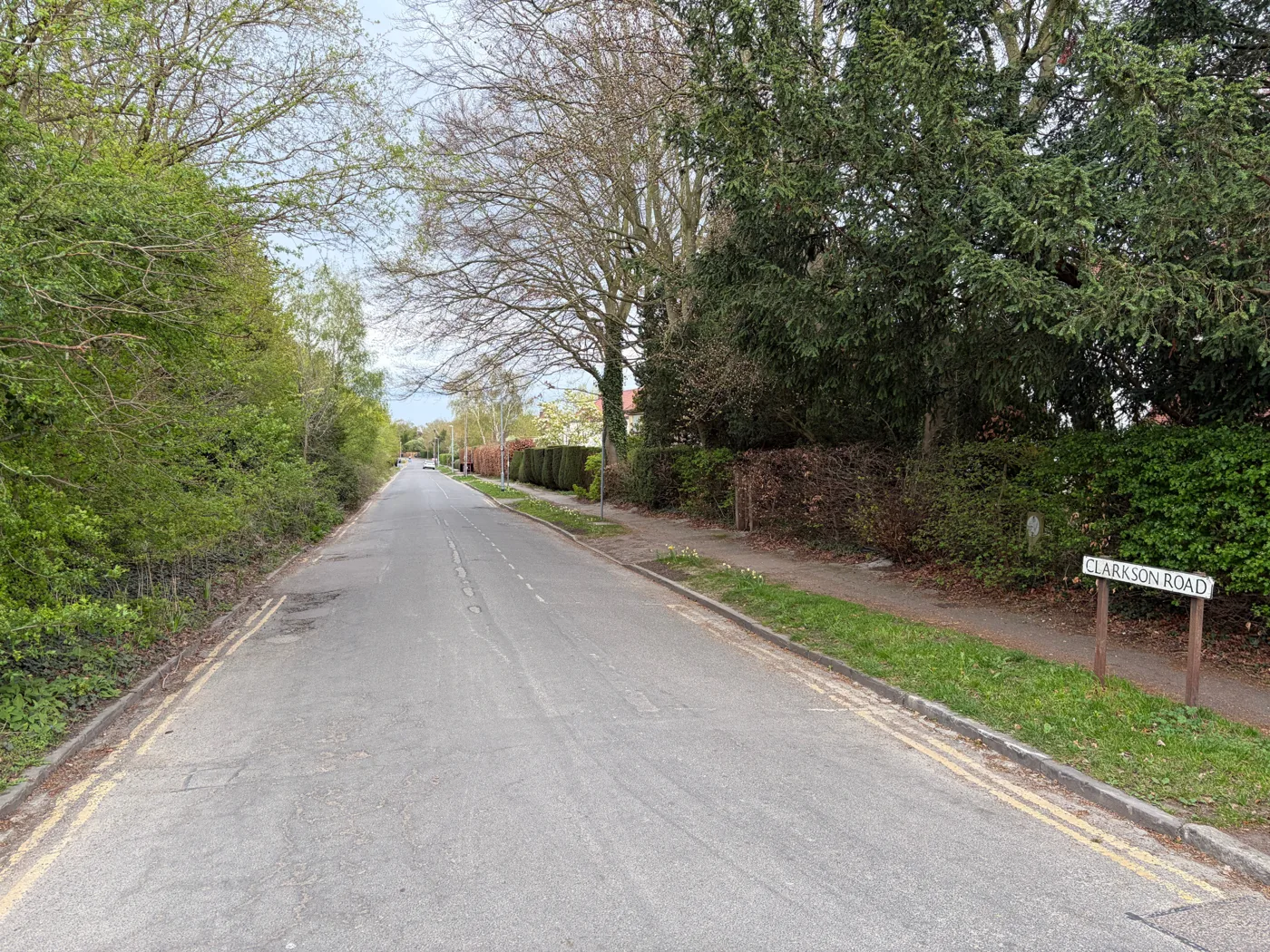

Councillors backed replacing 147 rooms at Wolfson Court, Newnham with 408, despite 21 objections. The register still shows the application awaiting decision.
Cambridge City Council’s planning committee has backed St John’s College’s plan to demolish Wolfson Court off Clarkson Road in Newnham and build 408 rooms in its place, almost three times the 147 rooms that stood there. The committee met at the Guildhall on Wednesday 29 July and approved the application in line with the officer recommendation. (Cambridge City Council)
It is not finished business. As of 17 August the Greater Cambridge planning register still lists application 25/04832/FUL as “awaiting decision”, because officers were recommended to approve it subject to conditions and to delegated powers to complete a section 106 agreement, and the council notes the decision is subject to the decision notice being finalised and issued. (Greater Cambridge Shared Planning)
What is being built
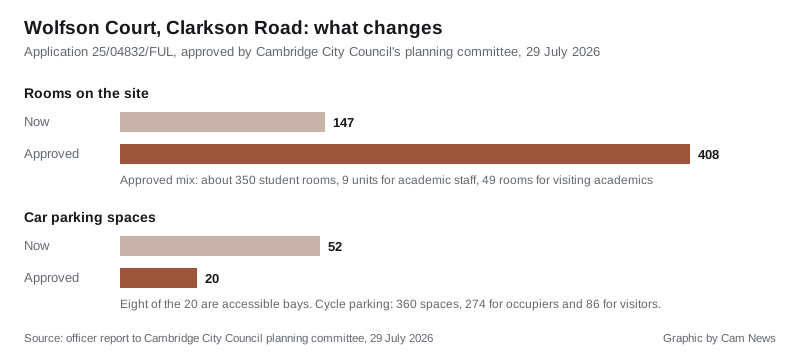
The 408 rooms are not all for students. The officer report puts the mix at roughly 350 student rooms, 9 units for academic staff and 49 rooms for visiting academics, spread across buildings of three and four storeys, including four three-storey townhouses on the eastern edge of the site. All rooms are en-suite, each floor gets a shared kitchen, and 19 rooms are fully accessible with level access throughout.
The site is empty at the moment. Its 147 rooms were rented to Lucy Cavendish College students and are no longer occupied because, in the report’s words, they do not meet the accommodation requirements of colleges. St John’s application is supported by letters from Lucy Cavendish and Newnham colleges setting out their own shortfalls.
Car parking falls sharply. There are 52 spaces on the site now, 10 of which serve the neighbouring nursery, and the scheme leaves 20, eight of them accessible. Students will be barred from keeping a car in Cambridge at all, other than in defined circumstances such as disability, and that restriction is to be written into the section 106 agreement and the student room licence. Cycle parking runs to 360 spaces, 274 for occupiers and 86 for visitors.
Newnham objected, and the residents’ association did not support it
The council received 22 representations on the application: 21 objecting and one neutral. The objections run to more than 30 separate grounds, led by construction traffic and damage, cyclist and pedestrian safety, the effect on trees and on the West Cambridge Conservation Area, overdevelopment, out of term use, noise and vibration, wastewater capacity and the conduct of the public consultation.
Councillor Rees objected, on cyclist and road safety, sustainability, damage to properties, environmental impacts, site management, antisocial behaviour and the consultation process. The North Newnham Residents Association made a representation that neither objected nor supported, raising scale and massing, future use of the buildings and construction vehicle concerns. Camcycle objected over the western shared path, the Madingley Road access, construction traffic management and the quality of the cycle parking.
Officers recommended approval anyway, concluding that the scheme is a landscape-led development sensitive to the conservation area and a significant upgrade on what is being demolished.
Trees, and the biodiversity shortfall
The site loses a group of three category B birches on the western boundary, a group of mixed category C trees, and individually one category B, 12 category C and four category U trees. Officers judged most of these to be poor quality and largely hidden from public view. A further group goes from the rear garden of 15 Madingley Road to make room for the new footpath and cycleway and a temporary construction access, with geogrid and geotextile layers laid to protect the roots of the trees that stay.
On biodiversity, the report is candid: the minimum 10% net gain cannot be fully achieved on the site, so the shortfall is to be met by buying off-site credits, secured through the statutory biodiversity net gain condition. A European Protected Species Licence from Natural England will be needed before two of the existing buildings can be demolished, because of bats.
The sewage question that now shadows every Cambridge application
Anglian Water lodged a holding objection, as it has been doing across the Cambridge catchment since the government decided in August 2025 not to support delivery of the new Cambridge Water Recycling Centre.
The numbers in the report are worth reading whatever you think of this scheme. Cambridge Water Recycling Centre is permitted to handle 37,330 cubic metres a day. On the 2024 figures verified by the Environment Agency it was already running at 39,354 cubic metres a day. In other words the plant that treats the city’s sewage is over its permit before a single new room is built.
Against that, Wolfson Court is small. The existing site was assessed at 175 litres per person per day; water efficiency measures bring the new buildings to about 110 litres. The net increase is put at just over 19,208 litres a day, roughly 0.04% of what the plant already processes. Officers concluded the increase was negligible, that Anglian Water had provided no specific evidence of attributable harm, and that a condition holding up occupation until capacity improves was not necessary. They also noted that Anglian Water has no statutory power to stop the council determining an application.
Councillors went slightly further than the recommendation on this point: the decision sheet records an additional informative asking the applicant to bring water use below 110 litres per person. (Planning committee decision sheet, 29 July 2026)
What the college has to pay for
The draft heads of terms for the section 106 agreement are short, because the accommodation is for students of Newnham, St John’s and Lucy Cavendish colleges and the Mathematics Institute, which the council’s contributions officer treated as limiting the requirement for obligations. They are:
- £60,000 towards improvements to the Madingley Road footpath and cycleway, payable before occupation
- £750 monitoring fee per obligation
- Occupation by full-time students during term time only, with out of term use controlled
- No keeping of cars in Cambridge except in defined circumstances
- A cap of 9 residential units for academic staff and no more than 49 rooms for visiting academics
What it means for you
If you live in Newnham, the change you will notice first is not the buildings but the lorries. The permission includes a temporary construction access off Madingley Road, with the largest vehicles at around 3.75 metres high, and construction traffic was the single most common theme in the objections. No start date has been published, and the formal decision notice has not been issued yet, so the section 106 agreement is the thing to watch: until it is signed, the permission does not exist on the register.
The lasting local gain is the £60,000 for the Madingley Road footpath and cycleway, which has to be spent before anyone moves in, plus a new pedestrian and cycle route through the site. The lasting local cost is 261 more rooms on a road that objectors already regard as difficult for cyclists, and a car park cut from 52 spaces to 20 on the assumption that almost nobody living there will own a car.
You can read the full application, the officer report, the objections and the eventual decision notice on the Greater Cambridge planning register under reference 25/04832/FUL, which was received on 12 December 2025 and validated on 22 December 2025. We track city applications on our Cambridge planning news page.
Have your say