
Councillors approved up to 3,800 more homes at Eddington on 16 September. The site grows to 5,648 homes, 2,648 more than the 2013 permission allowed.
Councillors have approved up to 3,800 more homes at Eddington. The Joint Development Management Committee backed the officer recommendation at its meeting on Wednesday 16 September.
The University of Cambridge is the applicant. Its two linked outline applications, 25/03746/OUT and 25/03753/OUT, cover 114 hectares of land between Huntingdon Road, the M11 and Madingley Road. The officer report put it plainly: the benefits “outweigh the potential environmental harm”.
Over 90 people had objected.
The committee’s own decision sheet records the outcome in one line: “Approved as per Officer recommendation, with amendments as per: Amendment sheet. Discussion at committee.” Minutes have not been published, so the voting figures are not yet on the public record and we are not repeating any that have appeared elsewhere.
The number nobody published before Wednesday
The amendment sheet handed to members on the day contains a table that is not in the officer report, and it is the clearest statement yet of what Eddington becomes.
| Stage | Homes |
|---|---|
| Granted by the 2013 outline permission | 3,000 |
| Phase 1, built and consented | 1,848 |
| Phase 2, approved on 16 September | 3,800 |
| Total across the whole site | 5,648 |
| Uplift over the 2013 permission | 2,648 |
So the decision nearly doubles what Eddington was ever permitted to be. The University’s own statement puts the total at “approximately 5,650” homes and says half the new ones will be affordable housing for University key workers.
Permission is not yet granted
The register still says otherwise. On 18 September, two days after the vote, the Greater Cambridge planning register recorded the status of both applications as “Awaiting decision”. That is not an error. The committee approved the applications subject to a section 106 agreement, and the decision notices cannot issue until that agreement is signed.
The report gives the deadline: 16 December 2026. If the section 106 is not completed by then, officers have delegated authority either to refuse both applications or to extend the deadline. Watch the Status field on the register, not the committee decision, for the permission actually existing.
What is being applied for
This is the second phase of Eddington, the neighbourhood the University began building in 2013. Almost everything is reserved for later: only the junctions onto Huntingdon Road were approved in full. The report sets a maximum for each use:
- up to 3,800 homes
- up to 52,000 sqm of co-living, which the report says is about 1,800 units
- up to 52,000 sqm of student accommodation, about 1,800 bedspaces
- up to 6,500 sqm of senior living
- up to 40,000 sqm of employment space and 60,000 sqm of academic space
- up to 3,500 sqm for shops, a nursery, health and indoor sport
Half the homes will be key worker housing for University and college staff, as required by the North West Cambridge Area Action Plan. That is the same 50% rule that applied to phase one. The University says the approved masterplan also provides accommodation for up to 1,675 students, taking student accommodation at Eddington to 2,000 homes, and up to 100,000 square metres of employment space.
The illustrative masterplan assumes a population of 12,633 people on the site.
How it compares with 2013
The 2013 permission allowed up to 3,000 homes and up to 2,000 student bedspaces across the whole development. Phase one has delivered far less than that, and phase two now asked for more homes than the original consent covered in total. That gap was the first of the three key issues officers put to the committee.
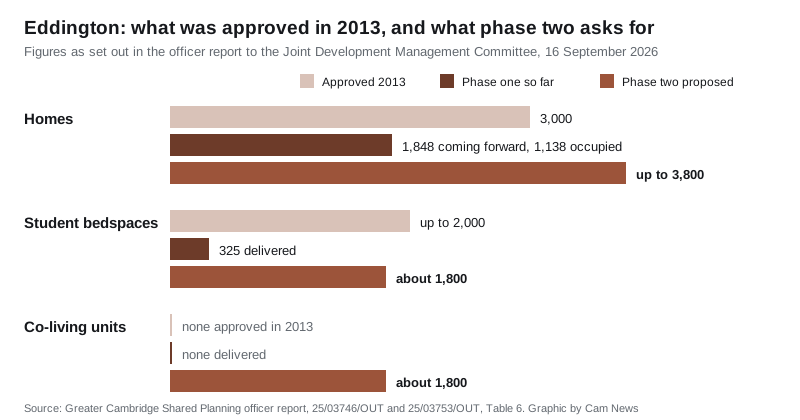
Of the 1,138 homes occupied so far, 686 are let to University key workers and 435 are market homes.
Heights are the sharpest complaint
Building heights run through almost every objection. The parameter plan puts the tallest forms, of seven and eight storeys, in the centre of the site around The Common and along Cartwright Avenue. Much of the rest is zoned for four to six storeys.
Officers say the edges step down. The land next to Conduit Head Road is capped at two storeys, one zone beside the conservation area was cut from four storeys to two during the application, and a no-build strip is fixed behind existing houses on Huntingdon Road, Storey’s Way and All Souls Lane.
The Cambridgeshire Quality Panel raised no concerns about the heights at either design review session.
Who has objected
Of the statutory and internal consultees listed in the report, one objects: Cambridge Past, Present and Future. Historic England, Natural England, the Environment Agency, National Highways, Anglian Water, Cambridge Water, Sport England, the county highways team and the police architectural liaison officer all raise no objection. Girton Parish Council sent no comment.
The objections come from residents and local representatives:
- Over 90 public representations object, on scale, height and density, green space, heritage, traffic, co-living, construction impact and consultation
- Councillor Hugh Clough (Cambridge City, Newnham) and Councillor Dr Peter Rees (Cambridgeshire County Council, Newnham) object on height, water shortage, density, pressure on medical services and school places, and the hydrology of Conduit Head Springs
- Nineteen Acre Field Residents Association objects on height and density near Huntingdon Road, and warns the scheme could worsen existing flooding there
- The Committee of Storey’s Way Residents Association objects on scale and storey numbers, and says the concept of co-living “was never discussed”
- Girton College supports the scheme overall but raises concerns about massing along Huntingdon Road and highway safety at the new Cartwright Avenue junction
Four representations are neutral. The reasons given are that Cambridge needs to expand its supply of homes, and that the new Cartwright Avenue junction is key to linking up the area’s active travel routes.
The money and the mitigation
Permission comes with a section 106 agreement, to be completed by 16 December 2026. The agreed heads of terms include:
| Obligation | Agreed contribution |
|---|---|
| Walking and cycling, Madingley Road | £800,400 towards the Greater Cambridge Partnership scheme |
| Libraries | £15 per person, up to £150,000, towards Darwin Green Library |
| Swimming pool provision | £236 per person (city), £225 per person (South Cambridgeshire) |
| Burial space | £34 per person, based on 1 sqm per person |
| Section 106 monitoring | £190,000 to the two district councils |
| Biodiversity monitoring | £5,680 per monitoring year, over 30 years |
| Schools | Up to one form of entry primary and two forms of entry secondary, by child yield |
On buses, the package covers more capacity on the existing U1 and U2, an orbital connection to north east Cambridge (U3) and a new southern orbital route (U4).
Open space is above the required standard in every category: 48.54 hectares of informal open space against 26.1 required, 14.97 hectares of outdoor sport against a requirement the amendment sheet corrected on the day from 14.6 to 14.16 hectares, 3.79 hectares of play space against 3.72, and 5.22 hectares of allotments and community gardens against 5.07.
What the amendment sheet changed
The amendments members approved alongside the officer recommendation are small but real, and they are on the public record only in the amendment sheet:
- Condition 62, the Huntingdon Road access. The trigger for building it was pulled forward from the 4,290th dwelling to the 3,169th, or the first occupation of the commercial development that depends on it, whichever comes first.
- A duplicated library obligation was deleted. The heads of terms listed the same £15 per person, up to £150,000, twice.
- Transport monitoring now starts at first occupation rather than on implementation, because, as the sheet puts it, there would be nothing to monitor before anyone moves in.
- Biodiversity net gain monitoring, £5,680 a year over 30 years, has its triggers tied to the phasing rather than to fixed years.
- The food waste vehicle contribution was reworded because the collection points could be above or below ground.
- Where the heads of terms use 3,000 occupations as a trigger, the sheet clarifies that only 1,152 of those fall to these applications, the rest having been delivered in phase one.
Two things officers do not resolve
Water. Cambridge Water has told the councils that growth beyond its current Water Resources Management Plan “may cause a risk of deterioration to the environment before new supply options are active”, and that the regional projects needed take long lead times. The University is still discussing supply with the company and would fund any booster station upgrades. Each reserved matters application would have to bring its own potable water strategy. We set out the wider pressure on the city’s water in what the new water law means for Cambridge.
Heritage. Officers accept the scheme causes “some harm” to conservation areas and the settings of designated heritage assets, and treat that harm as neutral in the planning balance once the parameter plans and design code are applied.
What the ward councillors asked for
Four councillors filed written statements. None opposed the scheme, and the asks in them are the things to hold the University to.
Councillors Rory Clark (Cambridgeshire County Council) and Cheney Payne (Cambridge City Council), for Castle ward, wrote that they support the application but “will remain critical neighbours”. They set two expectations: that infrastructure keeps being delivered ahead of new housing, and that construction close to existing homes is done considerately. They asked specifically for planning conditions on dust suppression and monitoring, citing problems at the Darwin Green site, and noted the GP surgery is “finally moving forward, after more than a decade of local campaigning”.
Councillors Richard Stobart and Corinne Garvie, South Cambridgeshire ward members, welcomed the outline but pressed on four points:
- an extended ambient heat network linking apartment blocks, which they say has not been fully considered, rather than roof-mounted central plant that competes with solar panels and green roofs
- a site-wide grey water solution, now that the Drinking Water Inspectorate is moving towards a governance structure permitting supply of grey water to homes
- adoption of the city’s proposed Urban Forest Strategy for the development, and micro-forests for water management, noise and shade
- a cycle route from Girton along the footpath on the western boundary of Girton College grounds, using the existing A14 bridge to link Northstowe, Oakington and Girton to Eddington
They also warned that the development will push extra car traffic off the A428 through Dry Drayton and Madingley, and that “a successful Eddington will disturb traffic patterns well beyond its immediate vicinity”.
What it means for you
- Nothing can be built yet. This is an outline permission with everything except the Huntingdon Road junctions reserved. Appearance, landscaping, layout and scale all come back as separate reserved matters applications, each consulted on individually. That is where residents get their next say, and there will be many of them.
- The section 106 deadline is 16 December 2026. Until it is signed, the register will keep saying “Awaiting decision” and no permission exists.
- Check the register, not the headlines. Both applications are on the Greater Cambridge planning register under 25/03746/OUT and 25/03753/OUT, with more than 470 documents between them.
- Minutes are weeks away. The Joint Development Management Committee publishes minutes at the following meeting, which is 21 October. The voting figures will be in them.
- Follow the decisions on our Cambridge planning news page, and see what the city’s water constraint means in what the new water law means for Cambridge.
Sources
- Joint Development Management Committee, agenda for 16 September 2026 for the meeting date, time, venue, livestream and the papers.
- Officer report on 25/03746/OUT and 25/03753/OUT for the recommendation, the development specification, the 2013 comparison, the consultee responses, the objections, the heights, the open space figures, the section 106 heads of terms and the water and heritage conclusions.
- Greater Cambridge Shared Planning, public speaking rights at planning committee (SCDC and JDMC) for the registration deadline and the three-minute limit.
- University of Cambridge, “University of Cambridge submits planning application for Eddington’s future phases” for the University’s own account of the submission.
- Joint Development Management Committee decision sheet, 16 September 2026 for the decision wording.
- Joint Development Management Committee amendment sheet, September 2026 for the 5,648 and 2,648 home figures, the corrected outdoor sport requirement, the condition 62 trigger change, the deleted library obligation, the transport and biodiversity monitoring triggers and the food waste wording.
- Joint Development Management Committee speaker statements, 16 September 2026 for the four ward councillors’ written statements.
- Greater Cambridge planning register, searched on 18 September 2026, for the status of both applications.
- University of Cambridge, “University welcomes approval for up to 3,800 new homes at Eddington” for the University’s statement, the approximately 5,650 total, the 1,675 student bedspaces and the quotations from Professor Anna Philpott and Matt Johnson.
This article was first published on 14 September 2026, before the committee met. It was rewritten on 18 September 2026 to report the decision of 16 September and what the amendment sheet changed.
Have your say